
What Are the Top Types of Board Electronics in 2026?
In 2026, Board Electronics will shape how products sense, compute, connect, and manage energy. The strongest designs will not depend on one component family. They will combine microcontrollers, processors, memory, power-management circuits, sensors, and communication modules. Each type solves a different engineering problem. Together, they determine a board’s speed, reliability, service life, and cost.
PCB consultant Bob Willis has said, “The PCB is the foundation of every electronic product.” That view remains useful when examining modern board architectures. A compact industrial controller may use an MCU for predictable control, an isolated power stage for safety, and Ethernet or wireless modules for remote access. A medical instrument may add precision analog circuits, secure memory, and carefully filtered sensor inputs. Meanwhile, FPGA and system-on-chip devices support demanding imaging, automation, and edge-computing workloads. Thermal paths matter too. A processor can appear efficient on paper, yet fail under continuous load if heat cannot escape.
This guide reviews the top types of Board Electronics expected to matter in 2026. It considers practical selection factors, including operating temperature, signal integrity, power density, cybersecurity, repairability, and compliance testing. The categories overlap. Real products rarely fit neatly into one box. That is worth remembering. A low-cost design may win early approval, then struggle with noise, aging connectors, or difficult maintenance. Reliable engineering requires testing beyond the prototype bench, including vibration, humidity, thermal cycling, and long-duration operation. Some predictions will be imperfect, because component markets and standards continue to change. Even so, these board technologies provide a grounded framework for evaluating current and emerging electronic systems.
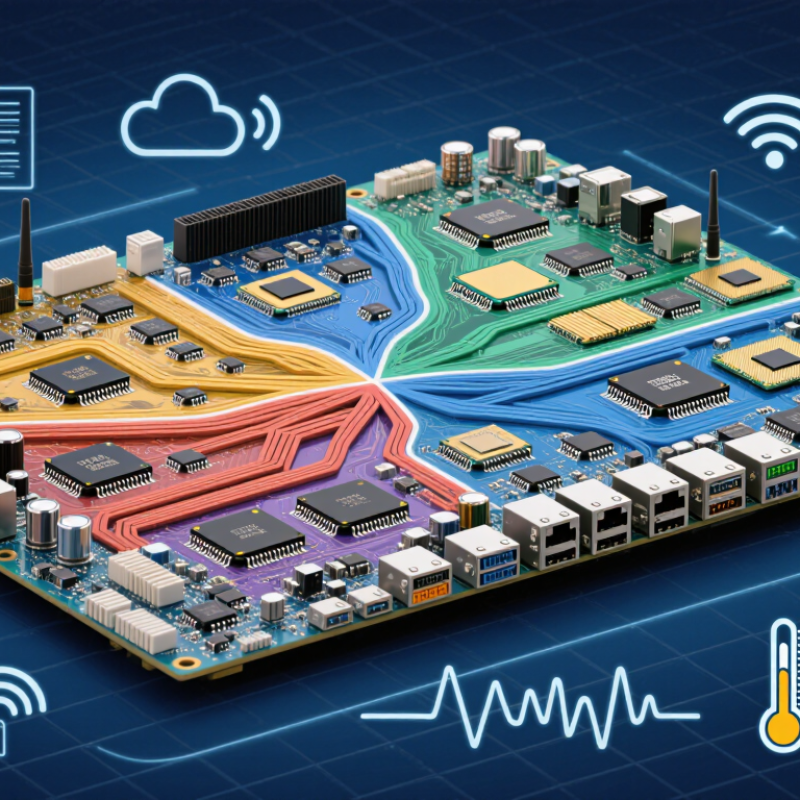
Definition and Role of Board Electronics in Modern Electronic Systems
What Are the Top Types of Board Electronics in 2026?
Board electronics are assembled circuit boards that control power, signals, data, and physical functions inside electronic systems. A typical board combines a PCB, integrated circuits, resistors, capacitors, connectors, sensors, and firmware. These parts work together like a compact nervous system. The board receives information, processes it, and sends reliable commands to other components.
In 2026, control boards remain essential in industrial equipment, appliances, vehicles, and medical devices. Power management boards regulate voltage, protect circuits, and distribute current without excessive heat. Communication boards connect systems through wired or wireless interfaces. Sensor boards measure temperature, pressure, movement, light, or chemical conditions. Embedded computing boards handle more complex decisions, such as image analysis and real-time machine control.
Their roles often overlap. A sensor board may also include communication hardware and a small processor. During practical testing, engineers inspect solder joints, connector alignment, thermal behavior, and software response. A board can pass a basic power test yet fail after vibration or repeated temperature changes. That weakness is easy to miss.
Reliable design requires documented test results, traceable components, safe insulation distances, and clear failure limits. Engineers should also verify electromagnetic compatibility and long-term power stability. I have found that simple faults often begin with overlooked details, such as a loose connector or poorly supported component. Perfect reliability is difficult. Continuous testing and honest review remain necessary.
What Are the Top Types of Board Electronics in 2026? - Definition and Role of Board Electronics in Modern Electronic Systems
| Type of Board Electronics | Definition | Primary Role on a Circuit Board | Typical Functions | Common Interfaces or Signals | Typical Application Areas | Key Design Considerations | Importance in 2026 |
|---|---|---|---|---|---|---|---|
| Microcontrollers (MCUs) | Single-chip computers that combine a processor core, memory, timers, and peripheral controllers. | Provide deterministic control for embedded products and real-time functions. | Sensor reading, motor control, user-interface management, protocol handling, and low-power control. | GPIO, PWM, ADC, DAC, UART, SPI, I²C, CAN, USB, and Ethernet interfaces. | Industrial controllers, appliances, vehicles, medical devices, measurement equipment, and smart devices. | Power consumption, interrupt response, memory capacity, temperature range, safety requirements, and firmware support. | Remain central to connected and energy-efficient embedded systems because they combine control, communication, and low power operation. |
| Microprocessors and Systems-on-Chip (MPUs/SoCs) | High-performance integrated devices containing one or more processor cores and, in many cases, graphics, memory, security, and communication functions. | Run operating systems, complex applications, graphical interfaces, and edge-computing workloads. | Data processing, multimedia, networking, artificial-intelligence inference, and human-machine interface control. | High-speed memory buses, PCI Express, USB, MIPI, Ethernet, display interfaces, and wireless-module connections. | Edge gateways, advanced displays, robotics, industrial computers, automotive systems, and intelligent appliances. | Thermal design, memory bandwidth, software compatibility, boot security, electromagnetic interference, and power delivery. | Support the movement of computing and analytics toward the edge, reducing latency and dependence on remote processing. |
| Field-Programmable Gate Arrays (FPGAs) | Reconfigurable digital devices made of programmable logic blocks, routing resources, and configurable input/output circuits. | Perform parallel processing, custom digital logic, timing-sensitive control, and hardware acceleration. | Protocol conversion, signal processing, image processing, data acquisition, and deterministic control. | LVDS, high-speed serial links, Ethernet, PCI Express, DDR memory, GPIO, and custom synchronous interfaces. | Test instruments, communications equipment, industrial imaging, aerospace systems, and specialized computing platforms. | Power density, configuration memory, timing closure, thermal management, signal integrity, and hardware-description-language expertise. | Useful where adaptable hardware, low-latency processing, and specialized acceleration are required without designing a new silicon device. |
| Memory Devices | Electronic components that store program code, configuration data, temporary working data, or non-volatile information. | Supply storage for processors, operating systems, firmware, measurement records, and user data. | Boot storage, program execution, buffering, event logging, calibration storage, and data retention. | Parallel memory buses, SPI, Quad-SPI, eMMC-style interfaces, SD interfaces, and DDR-family interfaces. | Embedded controllers, data loggers, networking equipment, consumer electronics, and industrial systems. | Capacity, endurance, retention, write speed, error correction, data security, operating temperature, and supply voltage. | Increasing data volumes and more capable embedded software make memory capacity, reliability, and secure storage important board-level requirements. |
| Power Management Electronics | Power-conversion and power-control circuits that regulate, distribute, monitor, or protect electrical energy on a board. | Convert an input supply into stable voltage and current rails for digital, analog, and electromechanical loads. | Voltage regulation, battery charging, power sequencing, load switching, protection, and energy monitoring. | DC input, regulated power rails, enable signals, power-good signals, I²C or PMBus monitoring, and feedback loops. | Battery-powered equipment, industrial control, vehicles, computing boards, medical instruments, and communications systems. | Efficiency, thermal dissipation, transient response, electromagnetic compatibility, voltage accuracy, protection, and component derating. | Higher processing density, battery operation, and energy-efficiency targets increase the need for precise and highly monitored power architecture. |
| Analog and Mixed-Signal Electronics | Circuits that process continuous electrical signals or combine analog signal paths with digital processing. | Connect the physical world to digital systems through measurement, amplification, conversion, and signal conditioning. | Amplification, filtering, voltage reference generation, analog-to-digital conversion, digital-to-analog conversion, and signal isolation. | Analog voltage or current signals, differential signals, ADC data, DAC outputs, SPI, I²C, and control lines. | Instrumentation, process automation, healthcare equipment, audio systems, energy systems, and scientific devices. | Noise, grounding, reference accuracy, linearity, sampling rate, dynamic range, layout, and thermal drift. | Remain essential as boards increasingly combine digital intelligence with precise sensing and control of real-world signals. |
| Connectivity and Communication Electronics | Components and modules that exchange data between a board, other devices, networks, or external peripherals. | Provide wired or wireless communication and support interoperability between electronic subsystems. | Packet transmission, radio communication, network access, protocol conversion, synchronization, and remote management. | Ethernet, USB, CAN, RS-485, UART, Wi-Fi, Bluetooth, cellular links, and low-power wide-area radio protocols. | Industrial networking, connected products, vehicles, building automation, asset monitoring, and edge gateways. | Antenna layout, EMC compliance, latency, throughput, security, coexistence, connector integrity, and environmental conditions. | Connected products require reliable communication, secure data exchange, and flexible interfaces across multiple network types. |
| Sensor Interface Electronics | Devices and circuits that detect, condition, digitize, and interpret physical measurements such as temperature, motion, pressure, or light. | Convert physical conditions into usable electrical data for monitoring and automated decisions. | Signal amplification, compensation, calibration, filtering, event detection, and sensor power control. | Analog outputs, resistive or capacitive signals, SPI, I²C, one-wire interfaces, pulse signals, and digital interrupt lines. | Predictive maintenance, robotics, wearables, environmental monitoring, vehicles, medical equipment, and smart infrastructure. | Accuracy, resolution, calibration, drift, response time, sensor placement, interference, and power consumption. | Support data-driven maintenance, automation, safety monitoring, and context-aware operation in intelligent systems. |
| Motor and Actuator Control Electronics | Power and control circuits that operate motors, valves, relays, solenoids, heaters, and other electromechanical loads. | Translate digital commands into controlled movement, force, flow, temperature, or switching action. | Pulse-width modulation, current regulation, position control, speed control, braking, and fault detection. | PWM, encoder feedback, Hall signals, current-sense outputs, CAN, SPI, I²C, and digital control lines. | Robotics, automation equipment, pumps, fans, appliances, electric transportation, and precision machinery. | Current handling, thermal performance, electrical isolation, feedback accuracy, switching noise, protection, and mechanical dynamics. | Enable efficient automation and electrification by combining intelligent control with precise power delivery. |
| Security and Trusted-Processing Electronics | Hardware features or dedicated components that protect data, firmware, device identity, and system access. | Establish trust during boot and operation and protect sensitive information from unauthorized use or modification. | Secure key storage, cryptographic operations, authenticated boot, secure firmware updates, and tamper detection. | SPI, I²C, secure storage interfaces, debug-control signals, cryptographic buses, and processor security links. | Connected devices, industrial systems, payment equipment, access control, vehicles, and critical infrastructure. | Key management, isolation, lifecycle control, update mechanisms, physical protection, compliance, and recovery procedures. | Security is increasingly treated as a board-level design requirement because connected systems face persistent software and hardware threats. |